Your pipeline and your books are the same program.
Not two systems that argue with each other. FoundrySuite does the CRM, the pipeline and real double-entry bookkeeping in a single local-first program, so the deal you close becomes the invoice you raise and the entry that posts — without anybody re-typing it, and without an export at the end of the month.
Windows, macOS and Linux. Thirty days, the whole product, no card and no account.
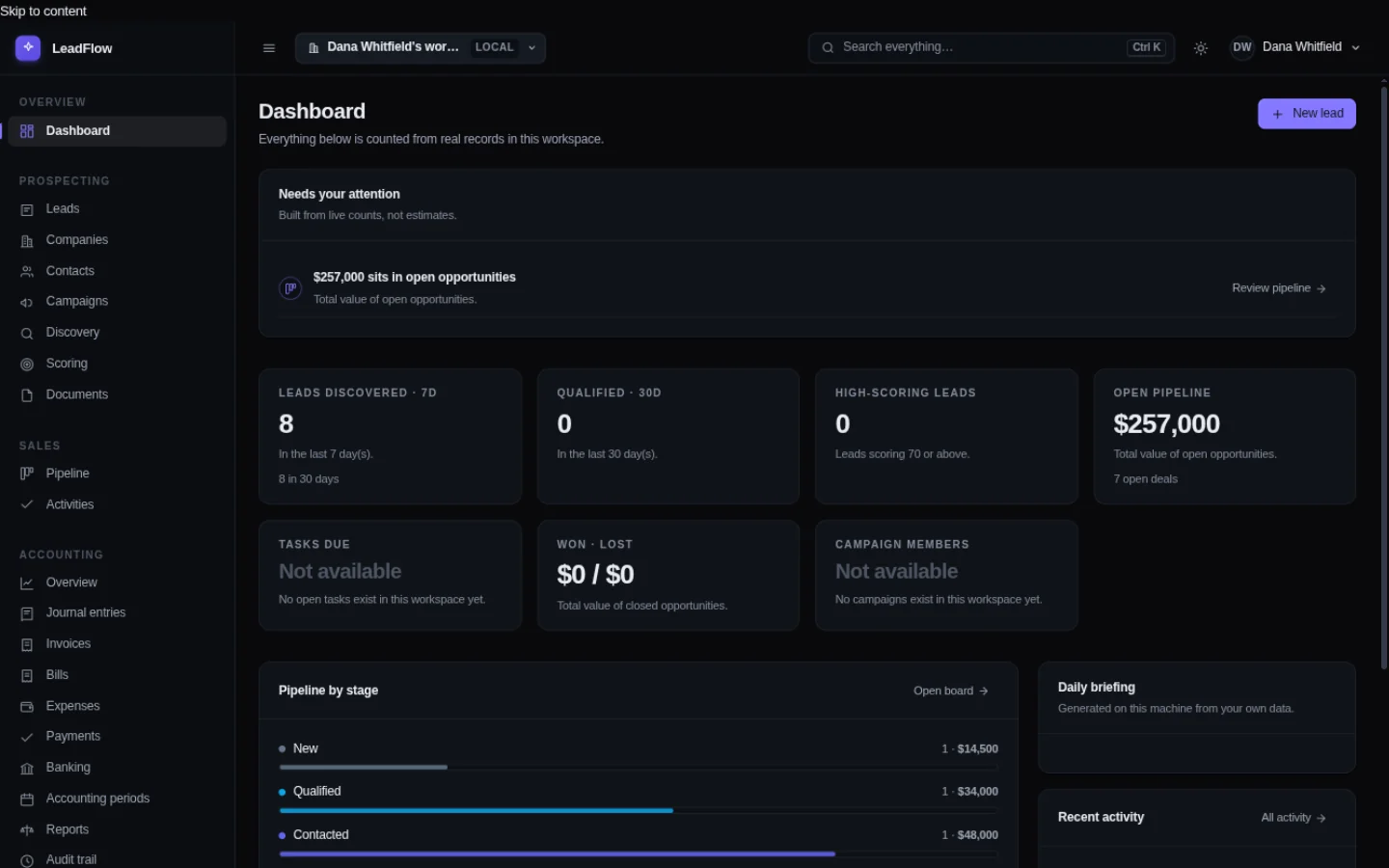
The seam that costs a small business the most time
Almost nobody loses a day to a spreadsheet. They lose it to the seam: the deal that is won in the CRM and has to be re-typed into the invoicing tool, the invoice that gets raised twice, the payment that arrives and does not match a line anybody remembers writing. The tool was never the problem. The problem is that the tools were built by two companies with no reason to agree with each other.
FoundrySuite removes the seam rather than papering over it. One database holds the company, the contact, the opportunity, the invoice and the journal entry. An invoice raised against a won deal is on the same row that moved it. A payment lands against the receivable it retires.
Nothing is synchronised because there is nothing to synchronise. See the screens, one after another →
What that means at the end of a job
- The pipeline is real. The stages you use, each deal carrying a value and a probability, weighted from the deals themselves rather than projected.
- An invoice posts through double entry. Money owed is not revenue until the work is earned; it moves when the work happens.
- The books are the authoritative record. Every posted entry balances to the cent or it is refused, and posted entries are immutable.
- Reporting is a query, not a project. The trial balance, aged receivables and the balance sheet come out of the same ledger that produced them.
What it actually does
Not a list of adjectives. Here is the product.
One pipeline, all the way down
Companies, contacts, leads, opportunities, invoices. A deal moves along the board; the invoice it becomes is the same record, not a copy made by somebody else.
Every figure on the board is a sum over real deals. Weighted value multiplies each deal by its own probability, so nothing is projected by a model.
Keep real books
A double-entry ledger that is the authoritative record. Invoices, bills, payments and expenses generate journal entries; the ledger is what is actually true.
Every posted entry balances to the cent or it is refused. Posted entries are immutable — a mistake is corrected with a reversing entry and a new one.
Read the paperwork
Drop in a PDF or a scan. Text is extracted locally, then read: what kind of document it is, what it says, and the fields printed on it — ready to file against an invoice, a bill or an expense.
No cloud OCR, no upload, no third party reading your documents.
Find companies that fit
Describe who you sell to. FoundrySuite searches for matching companies, reads their public pages, and extracts what it can verify — industry, headcount, location, contact details, the technologies they run.
Every value carries the URL it came from. Duplicates are recognised by domain, so the same organisation never appears twice.
Act on them
The model reads the research, drafts outreach, suggests the next concrete step, and summarises what happened. Everything it produces is a draft you edit.
There is no send button. Sending mail is your call, made in your mail client, through your own domain.
Work with other people
Multi-user, with the workspace enforced in code rather than by convention. Further accounts on a machine need an invitation code, so the person who finds an open laptop is not a data incident waiting to happen.
When it is reachable from a network, HTTPS is mandatory and the app refuses to start without it.
The product, running
Every image below is a screenshot of this software on a real machine. Nothing here is a rendering, a mock-up or a staged demo. There is a full walk through, screen by screen, on the tour page →
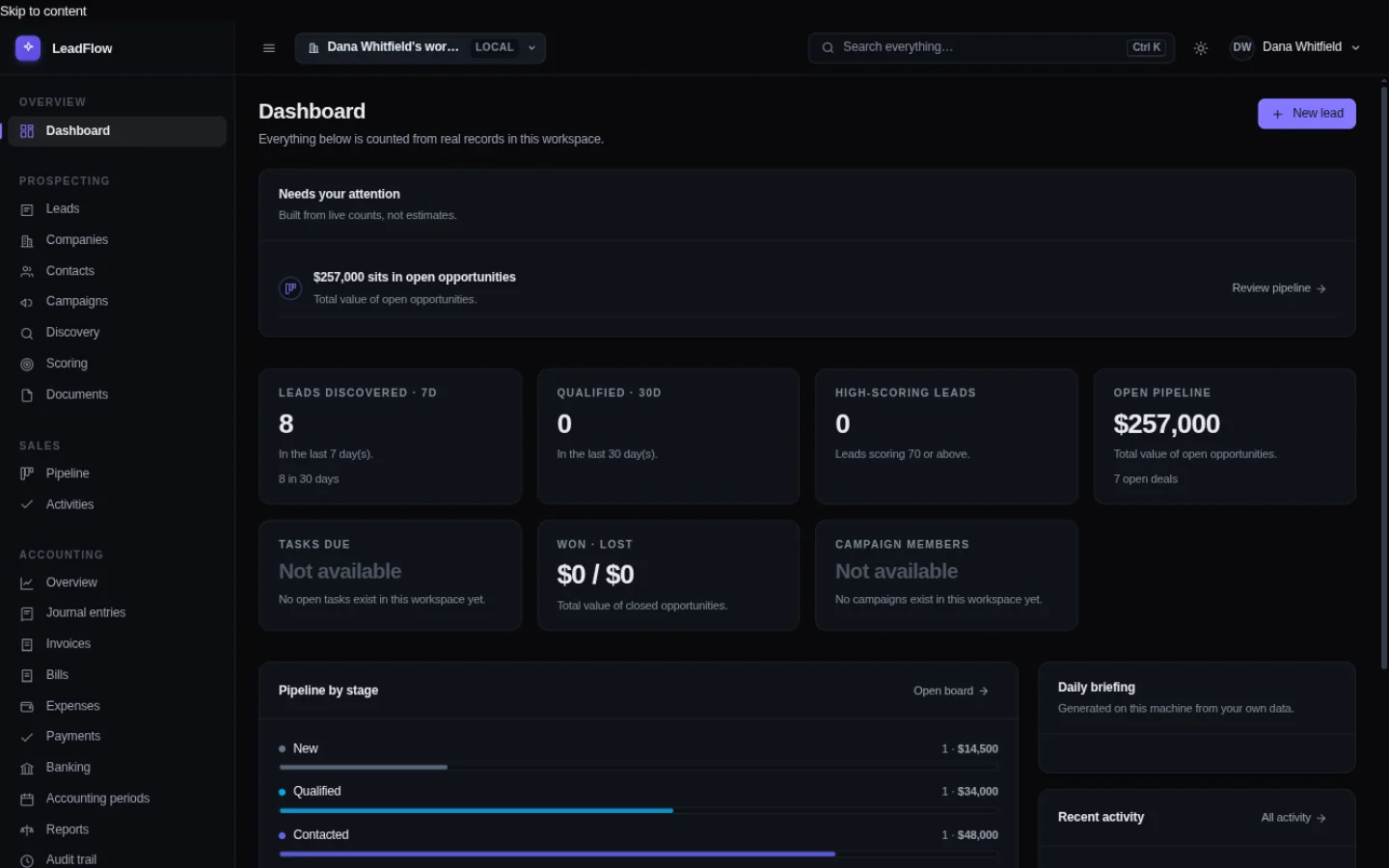
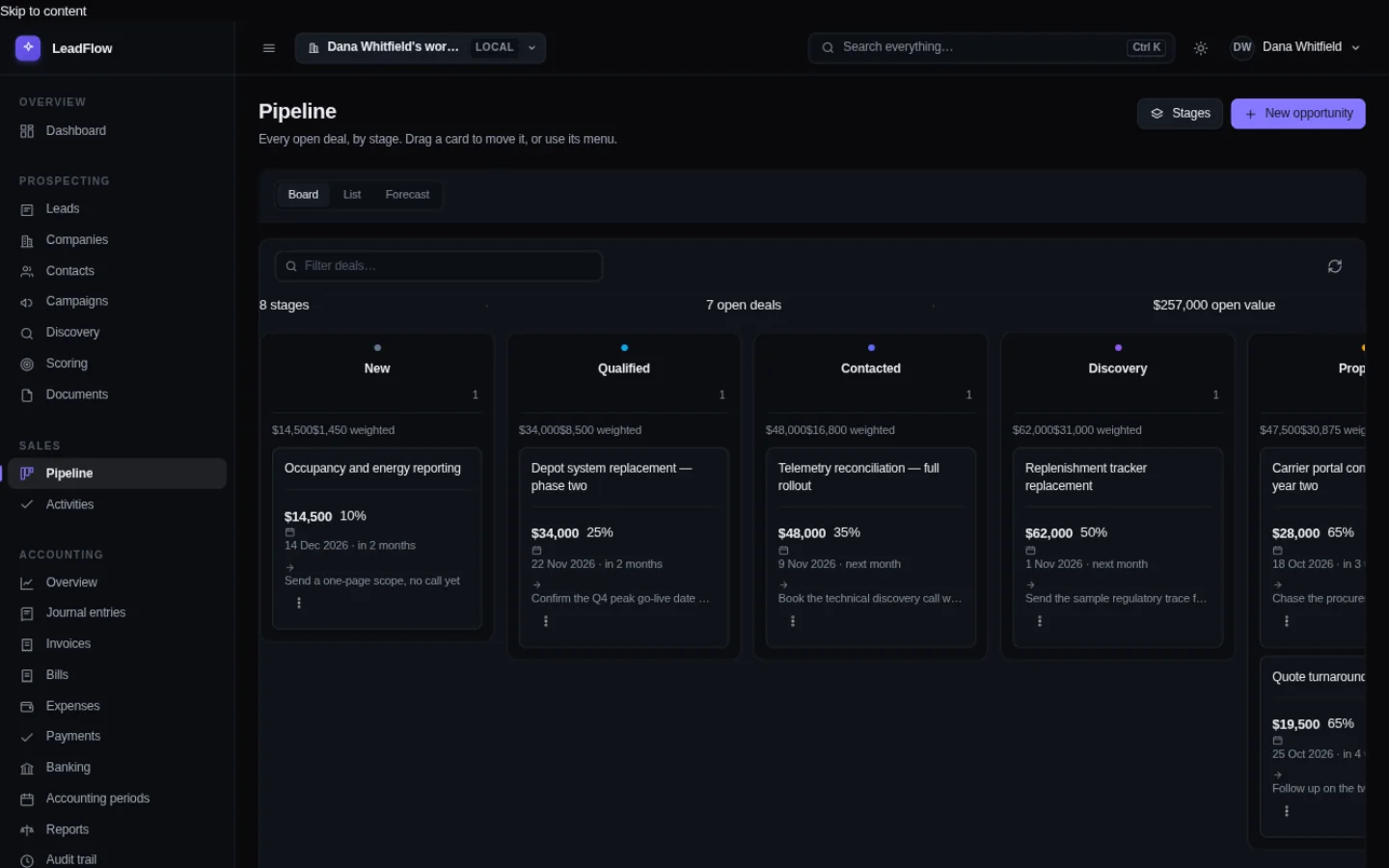
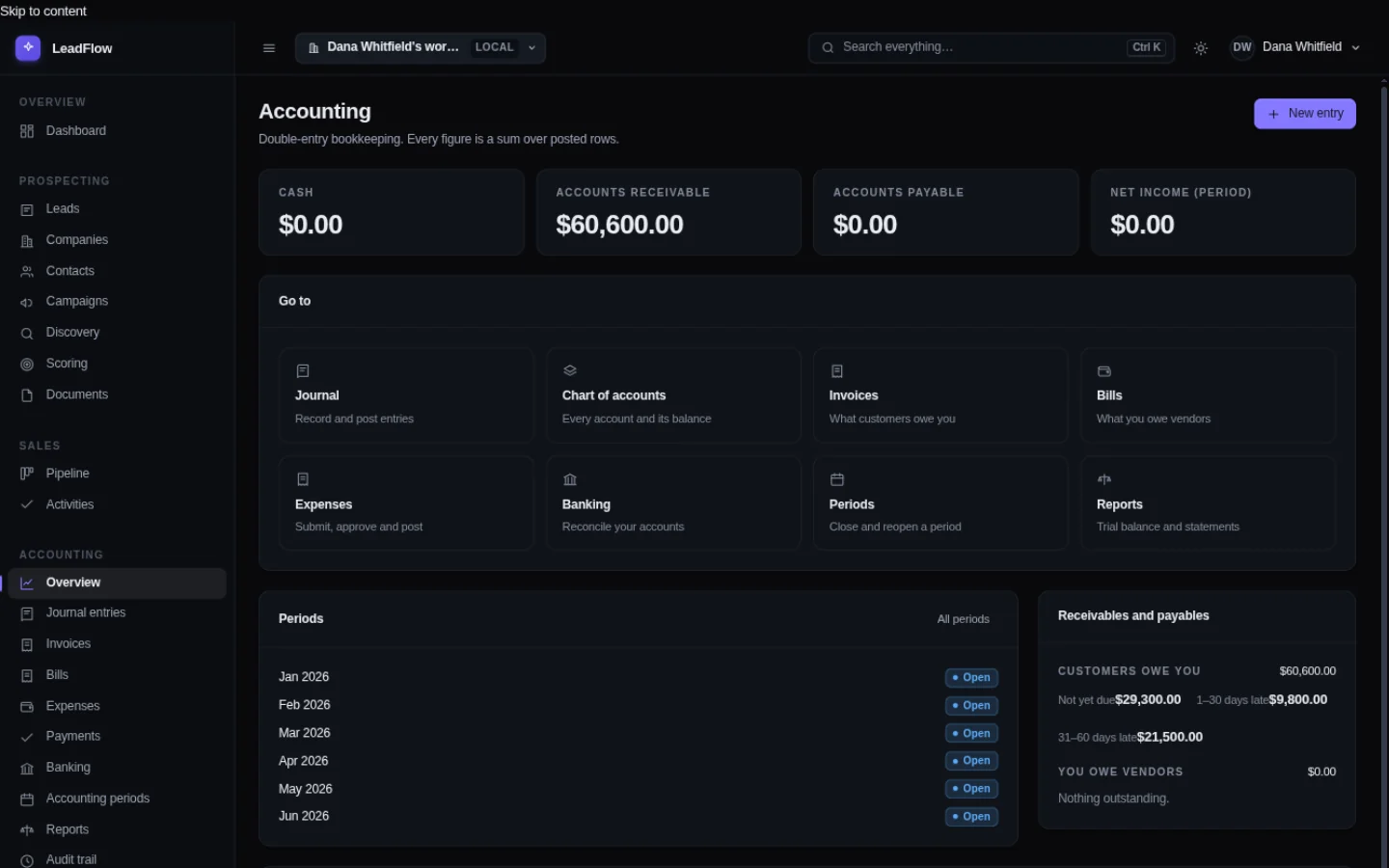
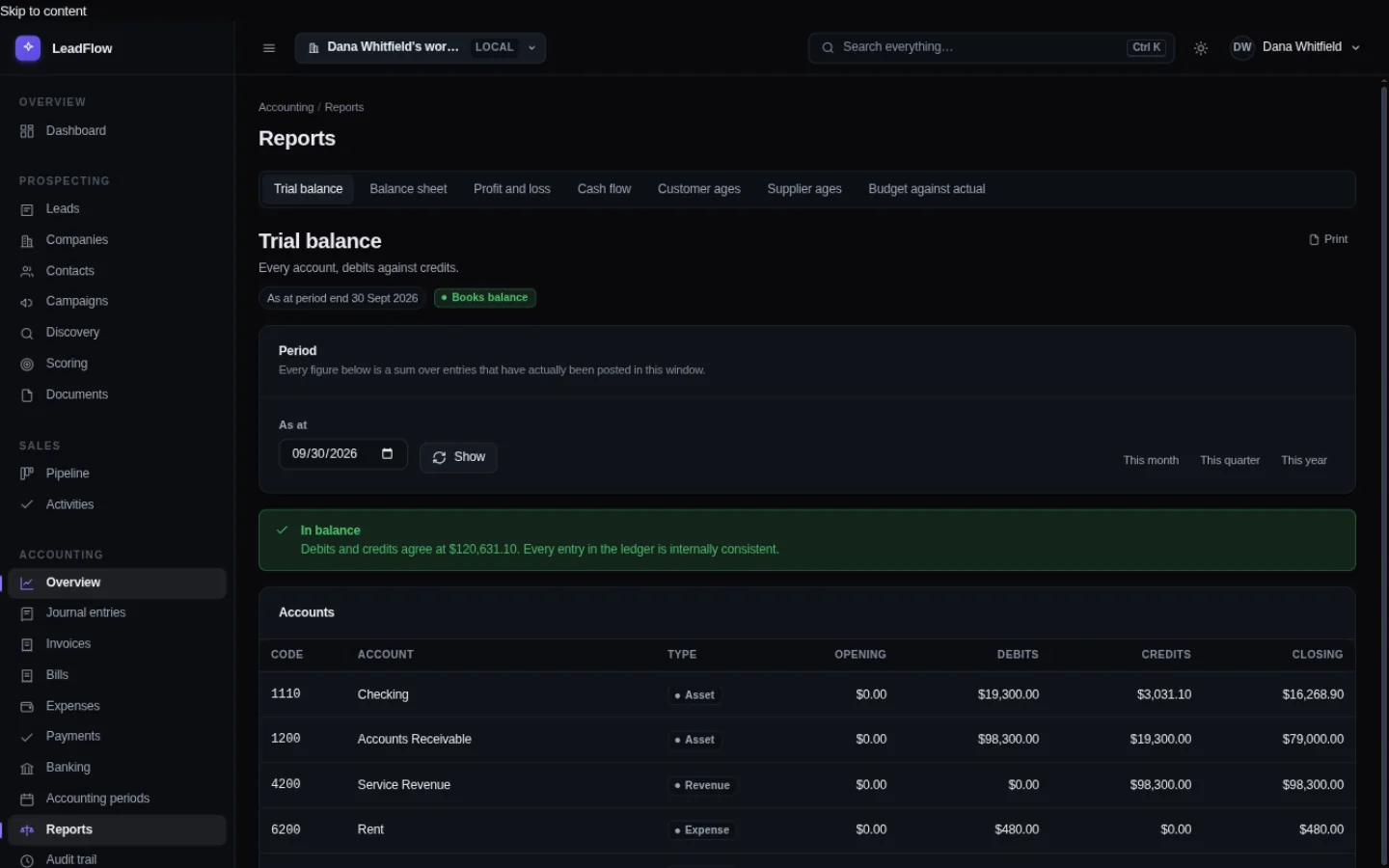
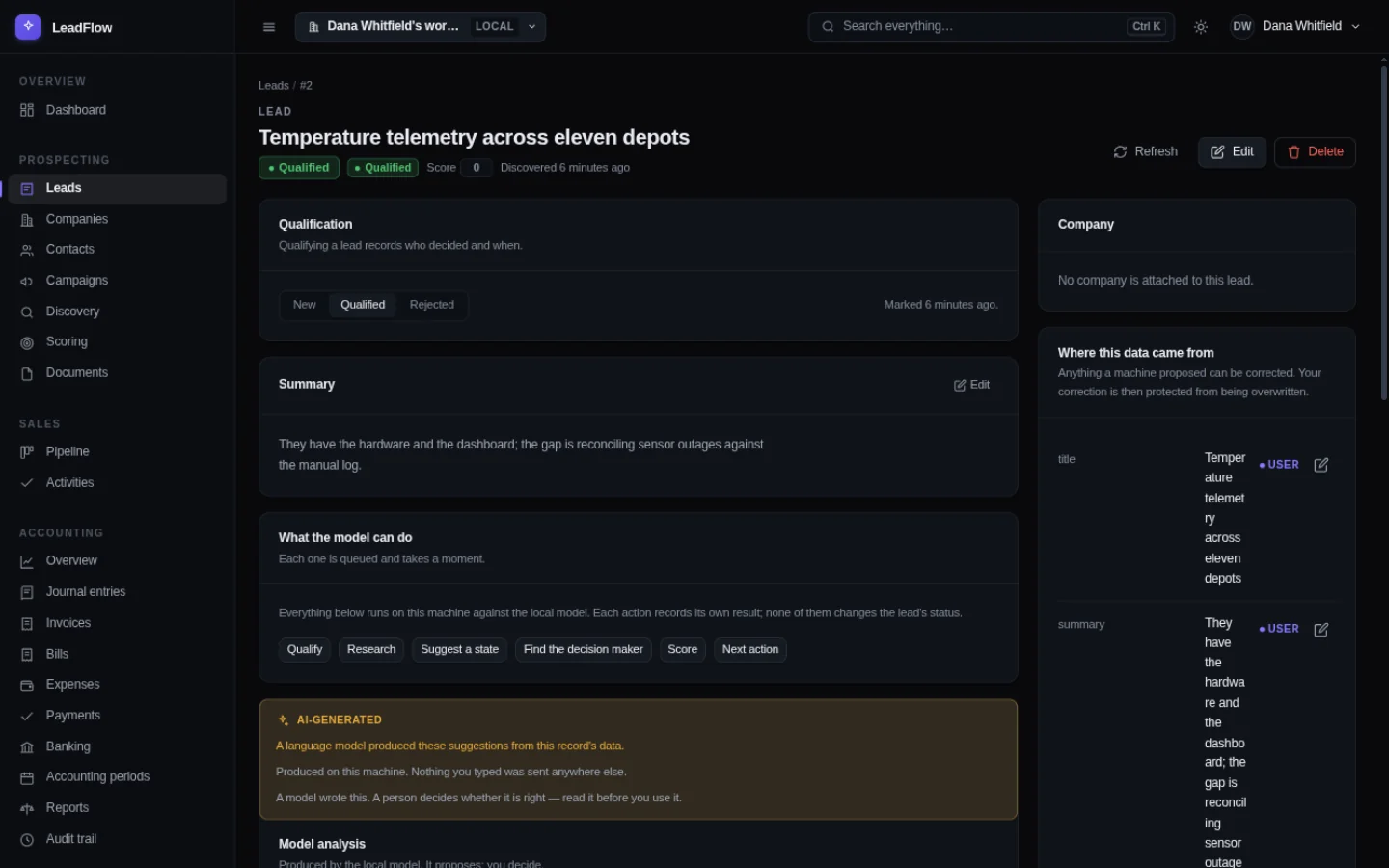
Nine more screens sit one click away in the sidebar: companies, contacts, leads, invoices, bills, expenses, the journal composer, the forecast, and aged receivables. Five of them are above. The rest are here because a page of pictures stops being evidence and starts being decoration.
The AI is the part worth explaining twice
Almost every piece of business software added “AI” in the last two years by connecting a small part of your business to somebody’s servers and billing you per use. That has a consequence people rarely discuss: the cost is not the feature, it is the standing arrangement with a company that now holds a copy of whatever you typed.
FoundrySuite runs its model on your own hardware instead. It drafts, summarises and classifies — and every one of those is a draft for a person. It cannot post to the ledger, cannot change a lead’s status, and cannot overwrite a correction you made.
We do not supply a model, and we do not host the weights. If you want one on this machine you provide it, or point FoundrySuite at an endpoint you run. The full list of what it may and may not do →
You can see it working, or not working
On every screen that shows generated content there is a visible notice saying so — what was generated, that you are responsible for it, and where the model ran.
Any value the software wrote carries its origin, a confidence value and a sentence of reasoning. You can ask any record where a value came from and get an answer.
For a business whose customers are starting to ask those questions, “ask our system” is a much better answer than “I think it was the tool”.
What it is not
Every product page should have one of these. Ours is written by the people who built the thing, so treat it as unusually accurate.
It is not a hosted service
There is no version of this running somewhere with your name on it, and there will not be one. If you want a browser-only product managed by someone else, this is the wrong purchase and we would rather you find that out now.
It is not a chatbot
There are four AI features, and they do four jobs. You cannot have a conversation with it. That is a limitation we chose, because the value is in work being finished rather than questions being asked.
It is not a marketing automation platform
It drafts outreach and keeps the records. It does not send mail, manage your domain reputation or warm up an address. There is no send button, and that is a decision about who is responsible for mail.
It is not a replacement for an accountant
The ledger is real, double-entry, and balances to the cent. It is also only as correct as what goes into it. If you need statutory accounts, payroll or tax filing, this is a system of record to hand to your accountant — not a substitute for one.
Who this was built for
Software is usually designed for the largest buyer and sold downward. This was designed for the middle, and it shows. The pages differ because the objections differ: a clinic’s concern is confidentiality, a van driver’s is signal, and a campaign’s is what happens to the donor list.
Who it is not for
- Anyone who needs staff in different countries working at the same time without a network you control.
- Large organisations whose actual requirement is multi-region resilience and a support contract with an SLA.
- Anyone who does not want to own the machine. There is no managed version. That is the product.
Questions people actually ask
Do I need to be technical?
If you can double-click a file, yes you can run this. The installer sets up a private environment inside the FoundrySuite folder and a launcher opens it afterwards. There is a command-line tool for people who want one, and nothing requires you to use it.
What happens on day 31?
The software stops starting and tells you the trial has ended. That is the whole mechanism — there is no remote switch and no feature that quietly degrades. Your data is untouched, and buying a licence later reopens the same installation with all of it intact. The thirty-day trial, in full →
Is the AI as good as the big services?
No, and pretending otherwise would be easy to demonstrate and would cost you later. It is a small model on your own CPU, which is fast enough for summarising a lead, drafting a paragraph and reading a document, and slow for a long reasoning task. If you want more, you can point it at a bigger model — locally or remotely — and it will tell you when it is doing that.
What if we are already in a cloud CRM?
Your export is a file, and this reads files. People move for any number of reasons and the least defensible one is “we could not get the data out”.
Will it work offline?
Everything except online research, yes. Lead the network cable out after you have the model and the CRM, ledger, document reading and AI features all keep working. Nothing on this site makes a third-party request either — that one you can check in the developer tools →
The one-sentence version, for the person who does the deciding
Still deciding?
Install it and put your own data in it. The thirty-day trial needs no card and no account, and you will know within an afternoon whether it fits your way of working.
If it does not, your whole business is one file you can copy onto a memory stick, and there is nothing to unpick.
Put a month of real work through it
Thirty days, the whole product, no card. Nothing is sent to us, and nothing is deleted if you decide it is not for you.